Confusing and sudden changes of guidance on shielding in parts of the UK
On 10 June we updated this article to link to the new guidance on shielding in Scotland, to add our members’ views and to discuss the distinction between clinically vulnerable and clinically extremely vulnerable.
The UK Covid-19 alert level is at level 4, the second highest. Level 4 means that ‘Covid-19 epidemic is in general circulation; transmission is high or rising exponentially’. In the absence of official confirmation of the alert level on the gov.uk website, we have had to rely on reports from the media to indicate that the risk level is unchanged.
The alert system was introduced to us in May, and in a speech the Prime Minister has explained that we have been at level 4 for the duration of the lockdown, and that these levels ‘tell us how tough we have to be in our social distancing measures – the lower the level the fewer the measures’.
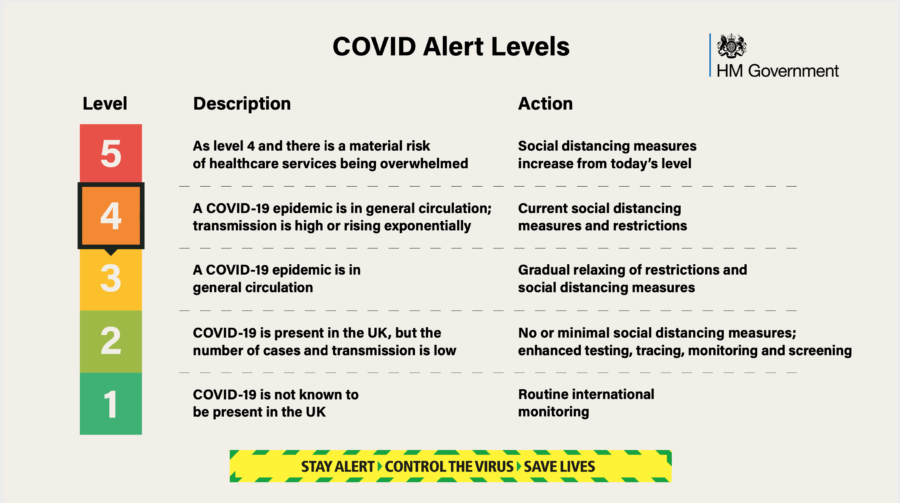
The alert level is set by the Chief Medical Officers of the UK on advice from the Joint Biosecurity Centre but the policy on lockdown is devolved to the four governments of the UK and is decided upon independently. Despite there being no change to the alert level, on the weekend, the UK Government announced changes in shielding advice for England. The announcement said: ‘People who are shielding remain vulnerable and should continue to take precautions but can now leave their home if they wish, as long as they are able to maintain strict social distancing.’
The new advice applies to the clinically extremely vulnerable category – those who will have received letters advising them to shield. There is a tier of people who did not receive letters but who are still defined as ‘clinically vulnerable, meaning [they] are at higher risk of severe illness from coronavirus’. This group includes much of our community on the basis of a weakened immune system, a neurological condition, among many other reasons. The guidance for this tier of clinically vulnerable people has not changed meaningfully since it was published on 11 May; the advice remains to ‘stay at home as much as possible and, if [they] do go out, take particular care to minimise contact with others outside [their] household.’
This was followed by an announcement of smaller changes in Wales that those ‘who have been shielding at home are now able to leave home to exercise or meet outside with people from another household’, while encouraging social distancing. There was an additional announcement from the Welsh Government this week indicating that the shielding measures in Wales will continue to apply until at least the middle of August.
The changes in guidance for England and Wales coincide with relaxation of the rules for general lockdown in both countries.
Guidance in Scotland has now been updated, advising a continuation of shielding until at least 31 July.
Guidance in Northern Ireland on shielding for vulnerable and extremely vulnerable people has not changed.
Impact on people living with genetic, rare and undiagnosed conditions
The sudden announcement of the lifting of shielding arrangements in England and Wales has left many in the genetic, rare and undiagnosed community feeling more exposed. The inconsistency between nations is concerning. The seeming contradiction of recently announced government policy about how lockdown will be lifted is worrying.
More than 78% of 132 of our members believe it is too soon to lift strict shielding advice in England. One of our members has commented that it would have been safer for those shielding to go out the week before the general lockdown lifts, than at the same time – it seems that extremely vulnerable people are being released at the least sensible time.
The change seems to be a political decision rather than a clinical or scientific decision. The Chief Medical Officers of the UK have been reported to have refused to lower the risk level to 3. Yet the governments of England and Wales have pressed on with reducing shielding advice.
This puts those people living with genetic, rare and undiagnosed conditions, who have received shielding advice in a very difficult position. The natural need to be part of society is brought into tension with our natural desire to be safe. Genetic Alliance UK does not believe that the risks have reduced sufficiently to warrant a change in behaviour for those members of our community who are shielding.
It is crucial that those shielding should be able to choose when they lower the protective measures they have created for themselves. People shielding should not be forced to lift their shield if they believe it is still unsafe to do so. It is crucial that all of the measures that local governments and essential services, including those from pharmacies and supermarkets, remain for as long as our community needs them.
This applies to the ‘clinically vulnerable group’ just as much to the ‘clinically extremely vulnerable’, many of this group have chosen to shield voluntarily – to have the formal shield reduced confuses their situation further.
We are very concerned that the UK and Wales governments’ sudden communication may damage public understanding of the need to continue supporting our community as they shield.